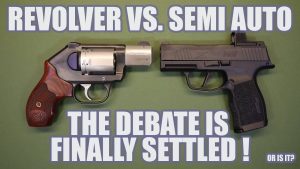
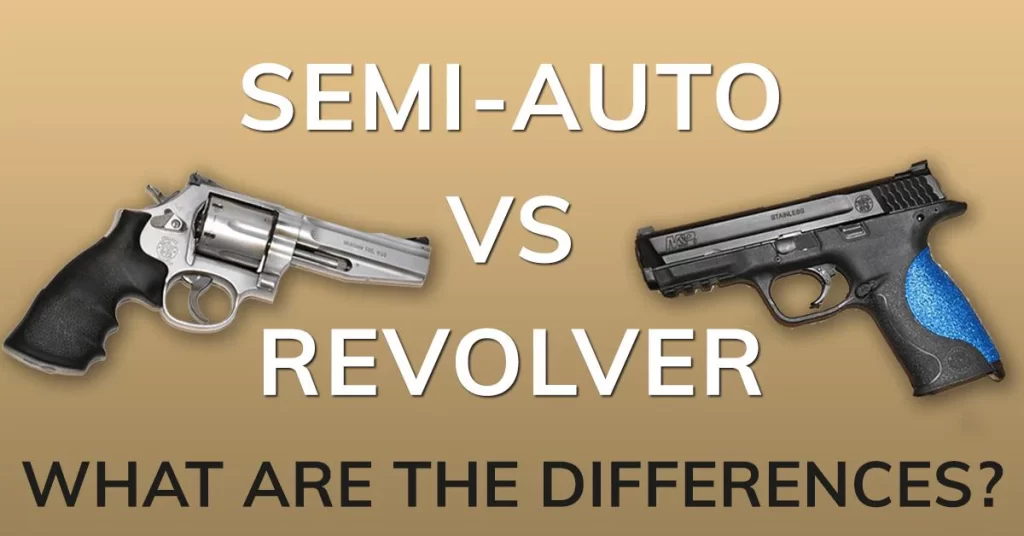
Choosing the right firearm for concealed carry is a decision that requires careful consideration. Among the most common choices are semi-automatic pistols and revolvers. Both have their unique advantages and drawbacks, and the best choice depends on your personal needs, preferences, and experience. In this blog, we’ll explore the key differences between semi-automatic pistols and revolvers to help you make an informed decision.
1. Understanding the Basics
– Semi-Automatic Pistol: A semi-automatic pistol uses the energy from firing a round to eject the spent casing and load the next round into the chamber. It typically has a detachable magazine that holds multiple rounds, allowing for quicker reloads.
– Revolver: A revolver has a rotating cylinder that holds several rounds, usually between 5 to 7. Each time the trigger is pulled, the cylinder rotates to align the next round with the barrel, ready to fire.
2. Capacity
– Semi-Automatic: One of the primary advantages of semi-automatic pistols is their higher ammunition capacity. Most semi-autos can hold between 7 to 15 rounds or more, depending on the magazine size. This can be a significant factor in self-defense situations where multiple rounds may be necessary.
– Revolver: Revolvers typically hold fewer rounds, usually between 5 to 7. While this is sufficient for many self-defense scenarios, it may feel limiting compared to a semi-automatic. However, revolvers are praised for their reliability, as there’s no magazine or slide to worry about malfunctioning.
3. Ease of Use
– Semi-Automatic: Semi-automatics generally require more training to operate effectively. You need to learn how to load the magazine, chamber a round, and handle potential malfunctions such as jams or failures to eject. For beginners, this can be a bit daunting, but with proper training, these skills become second nature.
– Revolver: Revolvers are often considered simpler to operate, especially for beginners. There’s no need to worry about magazines or slides. You simply load the cylinder, close it, and pull the trigger. The straightforward operation makes revolvers a popular choice for those who prioritize ease of use.
4. Reliability
– Semi-Automatic: Modern semi-automatics are generally reliable, but they are more prone to malfunctions than revolvers. Issues like failure to feed, stove-piping (where a spent casing gets stuck in the ejection port), or failure to fire can occur, especially if the gun isn’t properly maintained or if lower-quality ammunition is used.
– Revolver: Revolvers are renowned for their reliability. Their simple mechanical design means fewer things can go wrong. Even if one round fails to fire, you can simply pull the trigger again to rotate to the next round. This reliability is a significant advantage in high-stress situations where a malfunction could be dangerous.
5. Size and Concealability
– Semi-Automatic: Semi-automatics come in a wide range of sizes, from full-sized duty pistols to subcompact models specifically designed for concealed carry. These smaller models are slim and easier to conceal, making them a popular choice for everyday carry. The thinner profile of semi-automatics can make them more comfortable to carry, especially in an inside-the-waistband (IWB) holster.
– Revolver: Revolvers, especially those with shorter barrels (snub-nose), can be very compact and easy to conceal. However, they tend to be bulkier due to the width of the cylinder. While this bulkiness can be mitigated with proper holster selection, it’s something to consider when choosing a revolver for concealed carry.
6. Trigger Pull
– Semi-Automatic: Semi-automatics typically have a lighter and more consistent trigger pull, especially in striker-fired models. This can aid in accuracy, particularly for those who practice regularly. However, some models (like double-action/single-action pistols) have a heavier initial trigger pull, which can take getting used to.
– Revolver: Revolvers often have a heavier trigger pull, especially in double-action mode. This can make them harder to shoot accurately for beginners. However, this heavier pull can also act as a safety feature, reducing the likelihood of an accidental discharge.
7. Reload Speed
– Semi-Automatic: Reloading a semi-automatic is generally faster. You can quickly eject an empty magazine and insert a new one. With practice, this process can be completed in just a few seconds, making semi-automatics advantageous in situations where multiple rounds are necessary.
– Revolver: Reloading a revolver is slower and more cumbersome. You need to open the cylinder, eject the spent casings, and reload each chamber. Speed loaders can help, but they’re still slower compared to the quick magazine swap of a semi-automatic.
8. Maintenance
– Semi-Automatic: Semi-automatics require more frequent and thorough maintenance. Regular cleaning and lubrication are necessary to ensure reliable operation, especially because dirt, carbon buildup, or lack of lubrication can lead to malfunctions.
– Revolver: Revolvers are generally easier to maintain. The simpler design means fewer parts to clean and less chance of dirt affecting performance. This makes them a good choice for those who may not want to spend as much time on firearm maintenance.
9. Cost
– Semi-Automatic: Semi-automatics are available across a wide price range, from affordable budget models to high-end custom pistols. In general, they tend to be more expensive than revolvers due to their more complex design and higher capacity.
– Revolver: Revolvers are often less expensive, especially for basic models. However, high-quality revolvers can be just as costly as semi-automatics, depending on the brand and features.
Final Thoughts: Which is Right for You?
Choosing between a semi-automatic pistol and a revolver for concealed carry comes down to your personal preferences, level of experience, and what you prioritize in a firearm.
– Choose a Semi-Automatic if: You prefer a higher capacity, faster reload times, and a thinner profile for concealment. Be prepared to spend time learning how to operate and maintain your firearm properly.
– Choose a Revolver if: You value simplicity, reliability, and ease of maintenance. Revolvers are also a good option if you’re looking for a firearm that’s straightforward to use, with minimal chance of malfunction.
Both types of firearms have their place in the world of concealed carry, and many gun owners find value in owning and training with both. The best choice is the one that you feel most comfortable and confident with, ensuring that you can carry and use it effectively when it matters most.
Get Your Online LTC Training Started Today at RedZone LTC
Once you decide which type of handgun you would like, you should next get your License to Carry with our easy online class! Go to RedZone LTC and start today!
– Convenience: Complete the coursework at your own pace from home.
– Flexibility: Fits into your schedule without the need for in-person classes.
– Cost-Effective: Often cheaper than traditional in-person classes.